


Views: 0 Author: Site Editor Publish Time: 2026-04-09 Origin: Site


In modern mining and construction, project efficiency depends on more than the power of the main machine. The cutting tools installed on the cutterhead, milling drum, or excavator directly determine how effectively rock, coal, asphalt, concrete, and other materials are removed.
When cutting picks wear too quickly, break unexpectedly, or fail to rotate correctly, the consequences extend beyond tool replacement. Operators may experience lower cutting output, increased vibration, uneven surfaces, higher fuel or energy consumption, and unplanned machine downtime.
For this reason, cutting picks are increasingly being evaluated as critical engineering components rather than ordinary consumables. Their material structure, carbide tip, shank strength, wear protection, geometry, and compatibility with the machine all influence the total cost and productivity of a project.
Hengpu Laser develops cutting picks and wear-resistant engineering tools for road milling, underground coal mining, tunneling, subway construction, rotary excavation, and other infrastructure applications. Its product portfolio includes mining and construction cutting picks designed around actual operating conditions.

A cutting pick is the first component to contact the material being removed. Its function is to transfer mechanical force into the work surface and create controlled fractures or chips.
The cutting result depends on several connected factors:
Material hardness and abrasiveness
Pick geometry and attack angle
Carbide tip performance
Shank and body strength
Pick spacing and installation position
Rotation and retention condition
Machine speed, torque, and feed pressure
A pick with suitable geometry can help concentrate force at the cutting point. This allows the machine to break material more efficiently instead of crushing an unnecessarily large area. In suitable working conditions, better force transfer can improve cutting stability and energy utilization.
However, geometry alone cannot solve every wear problem. A pick may have a durable carbide tip but still fail because the steel body beneath the tip becomes severely worn. This is why modern cutting pick design must consider the complete tool structure.
Tool consumption is one of the most visible operating costs in mining and construction. A project may require hundreds or thousands of picks, depending on machine type, cutting width, material condition, and working hours.
Frequent pick replacement creates several forms of loss:
Direct spending on replacement tools
Labor required for inspection and installation
Machine downtime during changeovers
Lower production during abnormal wear
Potential damage to holders and cutting drums
Advanced cutting picks improve efficiency by maintaining a usable cutting profile for a longer period. Tungsten carbide alloy tips provide the hardness required for demanding cutting conditions, while the steel body provides structural support and impact resistance.
The objective is not simply to make one part extremely hard. Excessive hardness without sufficient toughness may increase the risk of cracking or breakage. Efficient tool design requires a balance between wear resistance, impact resistance, brazing quality, and overall structural strength.
Hengpu Laser supplies different cutting pick categories, including road milling bits, coal mining picks, roadheader picks, rotary excavator picks, and milling excavator picks. Each category is developed for a different machine interface and working environment.
Many users focus mainly on the carbide tip because it directly contacts the material. In practice, premature failure may begin in the steel body or shank below the tip.
When the body becomes worn:
The carbide tip may lose support
The pick may tilt or rotate abnormally
Cutting resistance may increase
The holder may suffer secondary wear
The entire tool may require early replacement
This is particularly important in abrasive rock, hard asphalt, mixed ground, and underground mining conditions. The body must resist repeated impact, friction, dust, and material flow while maintaining the position of the carbide tip.
Hengpu Laser applies laser-based metal-ceramic and ceramic 3D-printing technologies to selected wear-resistant products. The integrated wear layer is designed to combine the structural strength of the metal body with additional protection at high-wear areas.
This approach changes the design focus from “hard carbide tip only” to protection of the complete wear system. By extending the serviceability of the body and critical junction, the cutting pick can maintain more consistent performance during operation.
In continuous mining, tunneling, and road rehabilitation, downtime can affect the entire production schedule. A machine stopped for tool replacement is not producing, advancing, or completing the planned work cycle.
The impact is especially significant when cutting picks fail unpredictably. Operators may need to stop the machine, access the cutting head, locate damaged tools, remove worn holders, and install replacements. In underground projects, these operations can be difficult and time-consuming.
A wear-resistant pick helps improve efficiency by making tool replacement more predictable. When wear develops gradually and remains visible during inspection, maintenance teams can plan replacement during scheduled stoppages instead of responding to sudden failures.
For roadheader applications, cutting teeth must withstand axial pressure, cutterhead rotation, repeated impact, and abrasive contact with rock. Hengpu Laser’s roadheader cutting picks are designed for mine tunnels, transport tunnels, subway projects, water diversion engineering, and other non-blasting excavation applications.
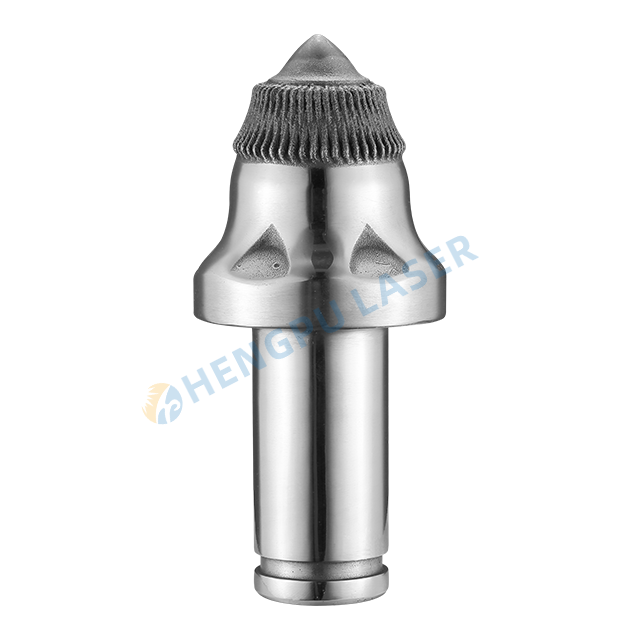
Many cutting pick systems are designed to rotate inside the holder during operation. Rotation helps distribute wear around the carbide tip and body instead of allowing one side of the tool to remain permanently exposed to the cutting force.
When rotation is restricted by dust, deformation, incorrect retention components, or holder damage, abnormal wear may occur. One-sided wear can shorten tool life and increase stress on the cutterhead.
This means cutting efficiency is connected to more than the pick itself. The following components must work together:
Cutting pick
Holder
Retaining ring or washer
Cutterhead or milling drum
Machine operating parameters
A correctly matched pick and holder system supports stable rotation and helps maintain the intended cutting angle. It can also reduce unnecessary wear on the holder and cutterhead, protecting components that are more expensive and more difficult to replace.
For road milling operations, this is especially important because uneven pick wear can affect milling depth, surface uniformity, and material removal consistency. Hengpu Laser’s wear-resistant road milling solutions focus on tool performance and whole-life operating cost rather than unit purchase price alone.
Different projects require different cutting pick designs. A tool suitable for asphalt milling may not be appropriate for underground coal mining or hard-rock tunneling.
Road milling picks must remove asphalt, concrete, and road-surface materials while handling impact, heat, dust, and abrasive particles. The pick must fit the milling drum and holder system accurately.
A suitable road milling bit can help maintain milling depth, reduce surface defects, and limit the frequency of drum maintenance. Stable wear also makes it easier to plan pick inspection and replacement during road maintenance projects.
Coal mining picks operate under continuous cutting conditions and may encounter coal, rock bands, moisture, and abrasive minerals. The tool must provide a balance of cutting performance, wear resistance, and impact tolerance.
Hengpu Laser offers round-shank cutting picks for underground coal mining machinery, with selection based on machine type and operating conditions.
Roadheader picks work in confined environments where tool access may be difficult and production interruption can be costly. Anti-crack performance, carbide support, shank durability, and correct retention are important considerations.
Reliable roadheader picks help maintain excavation progress and reduce the frequency of cutting-head maintenance.
Rotary excavator picks and milling excavator picks are used in foundation work, excavation, demolition, and infrastructure construction. These applications may involve reinforced concrete, rock layers, compacted soil, or mixed materials.
Hengpu Laser provides 3D laser-printed ceramic wear-resistant carbide picks for milling excavators, supporting applications where body wear and repeated impact are major concerns.
The main benefit is more stable material removal with fewer premature failures, tool changes, and interruptions.
No. Cutting picks must match the machine, holder, cutterhead or drum, material, cutting conditions, and retention system.
The body supports the carbide tip and transfers machine force. If the body wears or deforms, the tip may lose stability and fail earlier.
Performance should be measured through tool consumption, output, replacement time, holder wear, downtime, and total operating cost rather than purchase price alone.
Cutting picks improve efficiency by influencing every stage of the material-removal process. Their design affects cutting force, wear development, machine stability, maintenance frequency, and the service life of holders and cutterheads.
For modern mining and construction projects, the most effective solution is not simply the hardest or cheapest pick. It is a cutting pick that matches the machine, material, operating conditions, and required production target.
Through application-specific cutting picks and laser-based wear-resistant technologies, Hengpu Laser supports road milling, coal mining, tunneling, rotary excavation, and infrastructure construction projects. By focusing on tool life, predictable maintenance, and whole-life cost, advanced cutting picks can help contractors achieve more consistent output and higher project efficiency.


